
DDA '26 · Panel Recap · Education & Wisdom
Learning Beyond Data
What constitutes meaningful learning in an era of automation?
Raw inputs & facts
Organised & named
Context & meaning
Judgment & character
AI reaches steps 1–2 instantly · education must take us to step 4
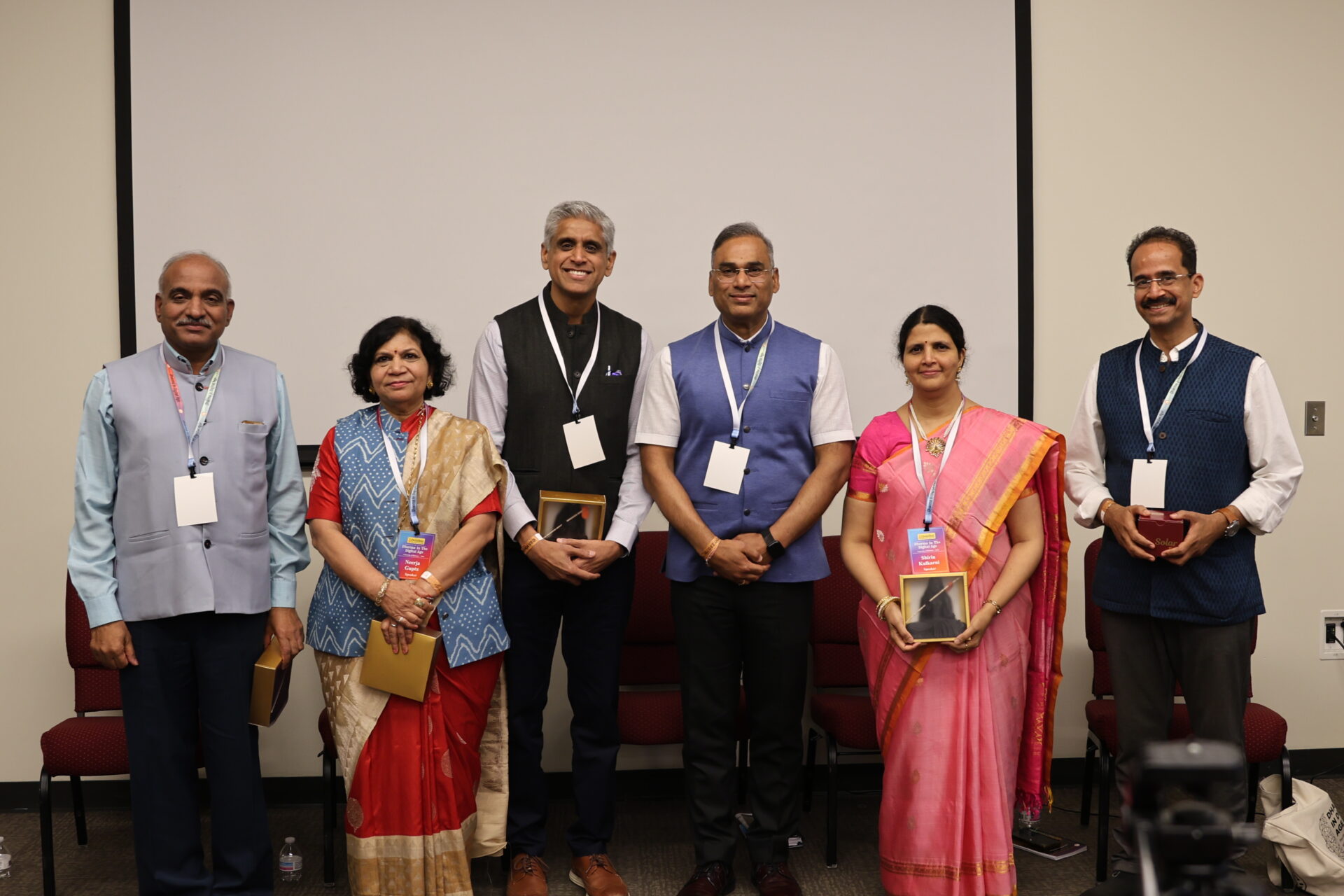
Education: Learning Beyond Data Panel · DDA '26 · University of Houston · June 2026
What is the primary purpose of education? — The room responded
Live audience word cloud · DDA '26 · Houston, June 2026
The session opened not with a slide deck but with a moment of stillness. Moderator Ashish Pandey asked everyone to feel their feet on the floor, take one conscious breath, and silently thank the people who have shaped their learning. Then he opened the word cloud above — and the room’s answers quietly dismantled the premise of most modern education systems. Nobody said “grades.” Nobody said “a good job.”
The question Pandey then posed was one he has been living with as a teacher: “What is the meaning of learning when everything is being converted into an algorithm?” He stopped giving projects to his first-year management students three years ago, because one student probably submits for the entire class of 137 and earns money in the process. The classroom, he observed, has become a church: teacher at the front, students receiving, week after week. AI is not creating this problem. It is accelerating it.
The frame for the session
“AI has taken the information part away and made it fast. But information → understanding → wisdom — that is the role of education beyond data.”
The panel’s shared conviction: data retrieval is not learning. The ladder from data to wisdom requires something no algorithm can supply — a relationship between a human being and a question they actually care about.
Who Was in the Room
The Panel
Professor, Shailesh J Mehta School of Management, IIT Bombay. 20+ years bridging academia and industry; 100,000+ students reached through online courses. Co-founder of Dhaviki and Panchkosha Well-being.
Education researcher and practitioner with 15 years helping schools worldwide implement the Finnish education model. Based in Finland.
Vice Chancellor, Gujarat University — 381 colleges, 500,000 students. Sanskrit and classical literature scholar whose live demonstrations in the session stopped the room.
Faculty at SMU Dallas in Operations and Supply Chain. Uses data analytics and machine learning for healthcare; has presented to the FDA and works with the VA.
Director, IIM Nagpur. Former Dean at MDI, industry experience at L&T. Asia Pacific Vice President of the Decision Sciences Institute, which he transformed into the global body ISDSI.
The room on AI risks in education
The audience was invited to name what worries them most about AI in learning. Every response pointed to the same thing: not that AI will replace teachers, but that it will replace the friction of thinking — and that friction, the panel would argue, is where learning actually lives.
Perspective One
Finland’s First Competency Is Not Maths — Shirin Kulkarni
Finland’s national core curriculum names seven transversal competencies that every student must develop. The first one is not literacy or numeracy. It is “thinking and learning to learn.” Everything else — multi-literacy, managing daily life, ICT, contributing to community — comes after that foundational capacity is in place.
Kulkarni described the moment this was made visible to her: she was on a flight and met an English language teacher who said students now use AI at home and come to class with answers they cannot replicate or explain when asked to do so in the room. The fluency is borrowed. The understanding is not there. Finland’s answer is not to ban the tools but to build the third layer of assessment that most systems ignore: assessment as learning — self-assessment and peer assessment, where students develop the capacity to evaluate their own thinking.
What happens when students use saws and sewing machines
In Finnish classrooms, children work with real tools — sewing machines, saws, hammers and nails. American educators who visit have their “jaws drop,” she said. The point is not the tool itself. It is that the hands-on work develops communication, collaboration, and the confidence to try something unfamiliar — with safety training first, then freedom. “All creativity centres are in our fingertips, literally,” she said. This extends to the digital age: engage children in hobbies that use their hands and their creativity centres stay active.
On what makes a teacher passionate: “Teachers who have their own philosophy become passionate because they know the purpose of their teaching.” The national curriculum in Finland gives teachers autonomy precisely because the structure is clear enough that each teacher can fill it with their own meaning. Passion, she argued, cannot be mandated or measured. It comes from knowing yourself well enough that your qualities flow naturally into your teaching.
She also introduced her own addition to the Five Ps of creativity (Person, Process, Product, Place): Patience. “Our patience level is three seconds,” she noted. Everything about the digital environment is designed to eliminate waiting. Learning requires exactly the opposite: the willingness to sit with something long enough for it to become yours.
She closed her contribution with an activity she does in workshops: ask everyone to write “You wow me because…” on a piece of paper and pass it to a neighbour. “We rarely appreciate each other,” she said. Happiness hormones are created in that moment. She recommends it in schools, for adults, at home. The learning environment is not about infrastructure — it is about whether people feel safe enough to share their worries and their questions.
Perspective Two
What AI Cannot Tell You About Gandhi or Kalidas — Neerja Gupta
Gupta brought the largest institutional perspective in the room — 381 colleges, half a million students — and used none of it. Instead she ran two live experiments that the panel will not forget.
Experiment 1: Ask AI where Gandhi learned ahimsa and satya
She invited the room to ask any AI: “From where did Bapu derive his principles of satya and ahimsa?” The answers came back scattered and plausible: Hindu traditions, Jainism, the Bhagavad Gita, his mother, Western influences, the Bible, Leo Tolstoy, John Ruskin, Henry David Thoreau.
Then she gave the answer from Gandhi’s own autobiography, My Experiments with Truth. For ahimsa: he learned it from Ba — from Kasturba, his wife. He was possessive; she would go out anyway; he would be angry; she would simply stand and smile. “I learned passive resistance from Ba. I learned how anger can be faced with the most pleasing manner.” For satya: in South Africa, British law required remarriage in Christian form. Kasturba refused. She said she would go to jail, eat only fruits, die if necessary — but she would not treat her own marriage as invalid. She held firm. Bapu said: “I learned satya from this.”
No AI gave this answer. Not one. “Which AI tells you the truth?” she asked.
Experiment 2: Why is Kalidas called the king of rasa?
The second experiment: ask AI why Kalidas is called the king of rasa. AI answers competently — celebrated for Shringar rasa, elevated from physical romance to spiritual. Then Gupta performed a scene from Abhigyanashakuntalam live. Shakuntala writing a love letter (Viyog shringar). Durvasa entering, wanting water. The audience moving through shanta, anxiety, bhaya, karuna — each emotion landing differently in different people. Durvasa shouting: “Whoever you are remembering will forget you.” The audience collectively in karuna rasa. Nothing changes — “and this happens generations after generations.”
“You cannot find this answer in AI,” she said. “It has to be demonstrated. It has to be experienced.”
Her conclusion from both demonstrations: AI cannot change two things — guru and sahiti (classmates and companions in learning). The relationship between teacher and student, and the relationship between learners themselves, produce something no retrieval system can replicate.
Gupta grounded the purpose of education in the Taittiriya Upanishad’s three goals for shiksha: shika earth curry (it should generate livelihood), yash curry (it should bring glory), and suk curry (collective happiness — never individual alone). “Shiksha is not only to produce a renunciate (tyagi) but also someone who can stand in the world with confidence (vaibhav).” The teacher’s gift is the confidence a student carries when they leave campus.
On the state of teaching: “How do you make a good teacher when you don’t make teaching the last available job?” When you treat the teacher’s position as equivalent to any top professional, she said, passionate people will come. The problem is not the individuals. It is the status we have assigned to the vocation.
Perspective Three
Philosophy Eats AI — Vishal Ahuja
Ahuja cited an article from The Atlantic asking: where have all the geniuses gone? Einstein, Niels Bohr, Feynman — what they had in common was not a special school. They had “many on one” relationships — many teachers for one student. That relationship has been replaced by the church model, and AI is accelerating the replacement. “Guru-shishya parampara has been alive and well for the longest time. The world is getting into church mode and AI is accelerating that path.”
The friction that IS the learning
Ahuja described the joy of finding an actual bug in your code — the hours of searching, the moment of discovery. “AI is supposed to remove friction. But through the process we forget that the friction, the struggle, is actually the learning itself.” When you hand that friction to a tool, you hand it the learning. His daughters have heard the same Akbar-Birbal story a thousand times and are still on the edge of their seats before the ending. “It’s about storytelling and keeping people engaged.” The emotion and the engagement are what convert information into something that stays.
At SMU, experiential learning means students work with actual companies — not simulated problems. He brings Fortune 500 CEOs as guest speakers. The partnership between SMU, Dallas companies, and startups is a deliberate attempt to reconstruct the kind of encounter Montessori described: learning through joy, through play, through contact with real stakes.
He quoted an MIT Sloan Management Review arc he finds clarifying: software eats the world (Marc Andreessen, 2011) → AI eats the software → philosophy eats AI. Which brings us back, he said, to 5,000 years of our tradition. He also noted something consistent across every AI-in-healthcare conversation he has: “Nobody has ever said I wish I had better technology. Everyone says: better culture, better strategy, better people.”
His one rule in teaching: “Students don’t care how much you know until they know how much you care.” And on the question of money and motivation: he wanted to directly push back on a cultural habit. “Making money is not bad. I want to get rid of this notion.” Passion and prosperity are not opposites. Competence — the feeling of being genuinely capable — is what young people most want to feel. And that can only be built through engagement, not through being told the answer.
Perspective Four
Data Tells You the Earthquake. Wisdom Tells You Whether to Act — Bhimraya Metri
Metri opened with the single distinction that anchors everything: perpetual learners are going to lead the world. Lifelong learning was once optional. Now it is essential. The question is what kind of learning, and for what.
When data lies — and how judgment corrects it
A Japanese dataset showed a direct statistical correlation between earthquakes and birth rate over five years. The correlation was real. The relationship was entirely accidental. “If we go by data only, data gives the decision. But as an individual we must apply judgment and wisdom.” He told a lighter version of the same point: at IIM Nagpur, ten years of data shows that when students leave for summer internship on 31st March, the temperature goes up; when they return on 15th June, it comes down. The graph fits perfectly. “But is it scientific?” Data without judgment produces conclusions that are technically accurate and practically absurd.
On competition versus cooperation, he offered Maruti Suzuki as a live case: 13 passenger car companies in India all purchase steel together from ArcelorMittal, achieving a 55% discount through cooperation. Then they compete fiercely in the market. “Six out of ten highest-selling cars always belong to Maruti.” He connected this to dharma: principled cooperation as the foundation within which competition is healthy. The Japanese precedent — no natural resources, no domestic market, and yet the world’s dominant economy for 15 years (1980–1995) — was built entirely on people management and teamwork.
The PMP that goes to the village
IIM Nagpur’s Professional Management Program sends participants to rural India for four days: living with farmers, learning from NGOs, making paneer, understanding how agricultural income works. They have funded eight projects that increased farmer income 5–10x. “The cream of society learns from real India.” The programme also trains rural women as drone pilots — 30,000 trained so far. “Pure dharma you find in a village,” he said. “If there is one grocery shop, another fellow will not open one. They will do something else. That is dharma operating without being named.”
On assessment in the age of AI: “Assess for the prompt, not for the answer. AI gives the answer. You assess the intelligent question.” IIM Nagpur is also assessing courage, confidence, and tenacity — qualities that no automated system can grade but that every employer and every community needs. He closed by coining a distinction — borrowing a word from Neerja Gupta — between shloka (a pinpointed answer) and gaveshana (research, from the word go meaning cow — when a cow was lost, finding it was a huge, open-ended task): “Are you approaching AI for a shloka or for gaveshana? How many other sources are you reaching out to?”
The Moderator’s Thread
Discernment Is the Decision — Ashish Pandey
Pandey wove a consistent thread through the session without foregrounding himself in it. His most direct statement of the central argument: “Analysis is being outsourced. Decision is the most important thing. The machine gives the analysis. We have to decide. And discernment and decision are deeply connected to values, which are reflected in character.”
He opened the session by asking everyone to feel their feet on the floor, take one conscious breath, and silently thank the people who have shaped their learning — before a single slide appeared. He shared that the Dalai Lama once gave him two words when asked for advice: “Breathe properly.” He said he still finds new meaning in those two words every day. Breathing connects concentration, the power to memorise, empathy, the meaning of life, and usefulness to others.
What the Room Brought
Voices from the Audience
Changing the narrative through AI
One participant shared that he is using AI to create two-minute material on Indian civilisation for each class — reaching principals of 300 high schools. He runs a platform (bharatheritage.com) specifically to correct historical narratives about India using the same AI tools that currently distort them. The tool is not the problem. The question is whose knowledge it is trained on and who is steering it.
The hockey-stick question
A participant asked a pointed question the panel acknowledged they could not fully answer: the hockey rule changed from grass to astroturf in the 1970s, and India lost its global dominance overnight because we had not built astroturf. “How do IITs and IIMs plan to change the rule of the game?” The “west is best” narrative did not arrive from nowhere — it was built into institutional structures. What would it mean to build the new field rather than just play better on someone else’s surface?
The teacher who felt irrelevant
A teacher in the room described feeling irrelevant. Her response: she taught her own daughter how to use four different AI tools — and then taught her to always ask for sources: “Give me the specific page or PDF you are drawing from.” She did not reject the tool. She taught her daughter to interrogate it. The panel considered this the most practical thing said in the session.
The grandmother and K-pop
Someone spoke about her grandchildren in the West who know K-pop inside out and know AI tools better than their parents — but have no relationship with Ganesha or Indian stories. She was not angry. She was genuinely asking: how? The panel’s collective answer: lead by example. If you scroll, they will scroll. Find something with your hands. Tell stories. Sit with them in the discomfort of not having an instant answer. That is where the transmission happens.
How the Session Closed
One Line Each
Each panelist was asked for a single closing statement. The five together form something like a manifesto:
“The future belongs to tradition with technology.”
“Synergy between emotions and economy will lead Bharat to its glory.”
“The best thing you can do is work on yourself. Dharmics is the future.”
“Education should become the core of every society — and that should become our dharma.”
“Conscious entrepreneurship — not technopreneur, not entrepreneur — conscious prneur.”
“Students don’t care how much you know until they know how much you care.”
Vishal Ahuja · DDA '26Watch the Full Session
The complete panel recording is available — including Neerja Gupta’s live performance of Abhigyanashakuntalam, the Maruti Suzuki cooperation case, the Gandhi experiments, and the breathing practice that opened it all.
Watch Now →