
DDA '26 · Panel Recap · Spirituality & Inner Life
Spirituality in the Age of Algorithms
Finding Stillness in the Noise
The Algorithm
Stimulus
No gap
Response
The Dharmic Path
Stimulus
The whole game
⏸ Pause
Chosen
Response
Awareness lives in the pause · What the algorithm erases, meditation restores
Six Recurring Threads · Key Takeaways
What This Panel Came Back to, Again and Again
Two Algorithms
One binds, one liberates. The engineered algorithm seizes your attention and never releases it. Dharma — “the algorithm of the universe” — once attuned to, sets you free.
The Pause Is the Whole Game
Attention is the currency of both the feed and the spiritual path. What the algorithm erases — the gap between stimulus and response — is exactly what meditation restores.
Consciousness Is Fundamental
From Schrödinger to the Upanishads, the panel located the “hard problem” in a mistaken materialist premise. Begin from consciousness as fundamental, and the limits of machines fall into place.
Material & Spiritual: One Coin
Inseparable yet distinct — life is their superposition. Wisdom lies in holding both rather than collapsing either into the other.
Dharma Is Contextual & Inward
Swadharma shifts with the moment. The durable ground is the inner, unencroachable space — the seed of a “dharma economy” for work and life alike.
The Remedy Is Practice
Every panelist ended not with a doctrine but a discipline — a daily review, a concentration exercise, a meditation, a fast from the screen.
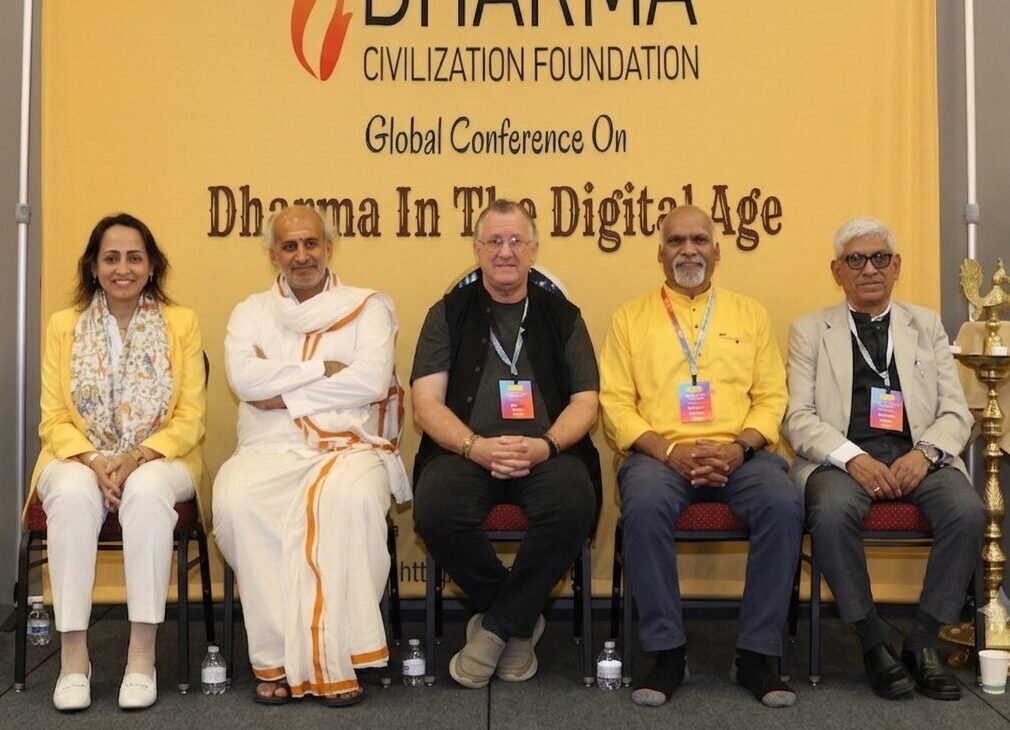
Spirituality in the Age of Algorithms Panel · DDA '26 · Hilton University of Houston & Student Center · June 2026
The moderator opened this session with a request for “Wall Street war-zone energy” and immediately gave it a different kind of charge — playful, alive, philosophically serious. He framed the conversation in three movements: first, defining spirituality, dharma, and algorithm; second, what the algorithm is doing to humankind; and third, how spirituality can help us live wisely with technology. He also set the tone with a small etymological game, noting that Ram means “that which pervades everything,” Sharda is another name for Sarasvati, and Jeffrey, of Germanic origin, means “the peace that passes all understanding.”
What followed was one of the most wide-ranging conversations of DDA '26 — touching Bhagavad Gita, Yoga Sutras, Mandukya Upanishad, Kena Upanishad, Gödel’s incompleteness theorem, Schrödinger’s view of consciousness, Indian astronomy, management science, and a broken ankle — all in service of a single animating question: what does a tradition built on inner intelligence have to say to an age built on artificial intelligence?
The question put to attendees
“What is your biggest digital distraction? Let’s discuss how to reclaim your focus.”
An audience member offered perhaps the session’s sharpest formulation: social media algorithms shape our attention externally; sanskaras shape it internally — both narrow perception and reinforce patterns. “Silicon Valley,” they said, “is industrializing avidya.”
Who Was in the Room
The Panel
Neuroscientist and student of Yogic-Neurosciences, exploring the convergence of brain science and contemplative traditions.
Padmashri awardee. 45 years at the Tata Institute of Fundamental Research at the chemistry–biology interface via nuclear magnetic resonance. Distinguished visiting professor in biosciences and bioengineering at IIT Bombay.
Professor at Elizabethtown College, Pennsylvania. Came to the dharma traditions after a childhood tragedy sent him on a lifelong inquiry into death, suffering, and existence — beginning with a copy of the Gita found at a church sale.
Professor at VU Amsterdam and Nyenrode Business University. Born in Suriname to a family that preserved its language, culture, and sanskaras across 150 years of migration. Two decades bringing spirituality into management scholarship.
Vedic Scholar & Mathematician, Professor-in-Charge at IIT Bombay. Studied the accuracy and optimality of algorithms in Indian astronomy. Trained in the Vedic lineage by his family and in science through the modern system.
Movement One
Defining Dharma, Spirituality, and Algorithm
Ramasubramanian opened with a compact thesis: “Algorithm guides processes; spirituality guides life.” He distinguished two ends of human striving — abhyudaya (material prosperity) and nihshreyasa (the fulfilment of moksha, “that beyond which nothing better can be conceived,” which resolves into shanti). Whatever leads you toward both, he said, is dharma. Spirituality he framed as the ancient inquiry — Nachiketa’s question to Yama — into whether anything exists beyond the mind–body–sense complex, since that complex cannot simply be taken as “I.” Where an algorithm increases the efficiency of a system already physically known, spirituality is the process of understanding what lies beyond that complex.
Asked later to connect Gödel’s incompleteness theorem to the dharmic view, he went to the Kena Upanishad’s opening: impelled by whom does the mind go where it goes? The parallel to Gödel is exact: if you associate yourself only with the mind–body–sense complex, the answer cannot be reached from inside — it requires stepping outside the system, the move the rishis supplied. He also cited the Mahabharata’s famous lament — I know dharma but do not act on it; I know adharma but am drawn to it — and named its cause: the nine obstacles (antarayas) of the Yoga Sutra, which he returned to later.
Hosur made the session’s central pun explicit: dharma is a procedure that sustains us and the universe — and a procedure is an algorithm. So dharma is an algorithm for your sustenance. He grounded the Bhagavad Gita’s claim that nothing is more sacred than knowledge, identifying its two components: material knowledge (what all scientists pursue) and adhyatmic knowledge (dharma, moksha, consciousness, superconsciousness) that cannot be verified by direct experiment yet cannot be denied. The Gita itself, he noted, is a yoga shastra — all eighteen chapters named as yoga, where yoga means both excellence in action and equanimity. Life, therefore, is a superposition of material and adhyatmic knowledge — two faces of one coin, inseparable.
Jeffrey turned to the Yoga Sutra’s yogash chitta-vritti-nirodhah — yoga as the calming of the waves of the mind. He offered a vivid image: picture the mind as a lake. When it is choppy, all you see are the waves — your thoughts, fears, desires, sanskaras — projected onto the world. When it is calm and steady (sthitaprajna), two things happen: the surface accurately reflects the surroundings, and it becomes transparent — you can see beneath, to the true self. He linked this to sleep: in dreamless sleep we come near this self (Mandukya Upanishad), and must draw near it regularly or we deteriorate. Meditation lets us do consciously what sleep does involuntarily.
He reframed the algorithm positively: dharma is the algorithm of the universe — attune to it, and lesser algorithms lose their power to distract. He quoted his Buddhist friend Bhante Sugata (“five minutes of quiet does wonderful things”) and George Harrison’s phrase “we are beggars in a gold mine.”
Nandram brought the definitions into the workplace, where “spirituality” risks being dismissed as vague. She defined it as a quality of any entity that connects the perceived and the beyond-perceived — a quality that can be developed, in a person, group, organisation, or nation. Her K-model operationalises this as a continuum of knowledge:
K1
Rational reasoning; the fully known. Input → process → output you already understand.
✓ AI operates here
K2
The not-yet-known that the same logical architecture can still reach.
✓ AI can gesture here
K3
The experiential; the bridge to the deeper unknown; the self, its ambitions and aspirations.
✕ AI cannot reach the core
The beyond-perceived. Not reachable by personal effort. The inexplicable everyone has brushed against.
✕ You cannot predict the same meditation twice
She argued that the unknown — K3 and K4 — is the wellspring of creativity, which we must actively tap. Dharma, she added, has layers: individual (your swadharma within the context you can control), social (respect for others’ views — “agree to disagree” against today’s polarisation), and cosmic (the governance you abide by).
Movement Two
What the Algorithm Is Doing
“Social media algorithms shape our attention externally; sanskaras shape it internally — both narrow perception and reinforce patterns. Silicon Valley is industrializing avidya.” — Audience participant
Jeffrey agreed that training the gap between stimulus and response is an essential part of the answer. He noted a telling symptom: a perceived acceleration of time — everyone exhausted, everything changing too fast — which the scriptures name as a mark of the Kali Yuga. But we are not powerless: the Gita is a message of courage and resilience. His practical counsel was simple: fast from your devices, set aside screen-free time, and rediscover printed books, which are not engineered to stimulate the same way. He was clear he is no technophobe — these tools are wonderful for spreading dharmic teachings. The problem is that our tools have become more clever than we are, and we are still learning to use them without becoming their instruments.
Hosur offered the Gita’s own account of how attention is captured and corrupted: dwelling on objects breeds attachment → attachment breeds desire → thwarted desire breeds anger → anger destroys discernment → lost discernment destroys the capacity to think. Krishna, as Yogeshwara, teaches the reverse: control the senses, act for the good of the world (loka) rather than the self, and remain content within. He reminded the room that the whole drama of the Mahabharata is internal: dharmakshetra is the body where we debate right and wrong; kurukshetra is the field where we act.
A distinguished participant in the audience, Dr. Kak, added a subtle reframing: the Mundaka Upanishad calls even the Vedas an avidya text — because it is the engagement, not the words, that matters. The same holds for AI: a machine only implements an algorithm, and equations cannot be conscious. But when your active consciousness engages with it, you can draw genuine knowledge from it. He proposed “AI as artificial nature” — just as a forest teaches and inspires, this new kind of nature can yield insight about ourselves. He quipped: “We are not even LLMs — we are SLMs, small language models.” The machine-like world compels us to confront our ordinary condition and ask how to admit the spark of the atman.
The Deepest Ground
Consciousness Is Fundamental, Not Emergent
Two questions pushed the panel toward its deepest territory. On the hard problem of consciousness — how does subjective experience arise from objective material processes? — Ramasubramanian returned to the Upanishadic “eye of the eye.” Before the manifest universe there was only Sat (existence); the atma carries the irreducible sense of “I,” absent in mere conglomerations of matter. The entity beyond change presents as Sat–Chit–Ananda — being, consciousness, and bliss (which surfaces in the calm of deep sleep). It is approached by many paths because different practices appeal to different people according to their vasana — the inherited tendency that distinguishes identical twins with identical DNA.
The moderator sharpened the contrast: the algorithmist feeds data → output → data → output with no pause, but the answer lives in the pause — between the inhalation and the exhalation. He invoked Ramakrishna’s salt doll, which set out to measure the ocean’s depth and dissolved into it. His epigram: “Zero data, zero parameters, infinite intelligence is spirituality.”
On whether a computer could ever be conscious, Dr. Kak cited a paper arguing from mathematics and quantum mechanics that algorithmic systems will never be conscious — not in five years, ten, or a thousand. Hosur reinforced it with Schrödinger: consciousness is fundamental and cannot be reached through the material world — it belongs to a different, transcendent domain. Jeffrey pressed the philosophical point: the materialist assumption — that dead, unconscious matter is fundamental — is what creates the hard problem. Begin instead from consciousness as fundamental (we generate whole worlds in dreams), and the material world becomes an unproblematic projection. His diksha guru’s reply to “how would we know if an AI became conscious?”: “How do I know that you are conscious?”
A Question from the Room
Finding Your Swadharma
A young attendee asked how one discovers one’s own swadharma. The panel answered in layers.
Hosur: The Gita’s chaturvarnya is assigned “by guna and karma,” not by birth. As you develop, you are intrinsically drawn to a particular activity; so long as it harms no one, that is your swadharma. No one else can tell you — you realise it yourself, excel at it, and keep doing it without attachment to the fruit.
Jeffrey: Apply two tests, and a third that matters most. First, you must excel at it. Second, it must bring you joy — feel less like work and more like your authentic self (excellence without joy is the road to a midlife crisis). Third, and highest: does it serve all beings? The right activity is the one suited to your mind–body complex, that gives you joy, and that contributes to the world.
Ramasubramanian: Swadharma is contextual. Krishna directed the ahimsa-upholding Arjuna to fight, because what must be executed depends on the act and the moment. Dharma cannot be fixed once and for all; we instead train the mind toward purity, dissolving the doubt (samshaya) that clouds decision. A clear mind resolves such dilemmas effortlessly.
K Ramasubramanian
The Nine Obstacles — Antarayas
Ramasubramanian walked through the Yoga Sutra’s nine antarayas — the obstacles that block any pursuit, spiritual or worldly — noting first the distinction between vyadhi (physical ailment) and adhi (mental affliction), and that the mind often governs the body.
1
Vyadhi
Physical or mental illness (i.e. a migraine or injury that stops you practising.)
2
Styana
Mental inertia (i.e. the inability to organise or decide what to do.)
3
Samshaya
Doubt and dilemma (e.g. Arjuna’s paralysis: “should I, should I not?”)
4
Pramada
Negligence (e.g. wanting the goal while refusing the sadhana that reaches it.)
5
Alasya
Heaviness of body and mind (e.g. more than mere laziness.)
6
Avirati
Craving and restlessness (e.g. the “never enough” that chases X, then 10X, then 100X.)
7
Bhranti-darshana
Illusion (e.g. taking wrong for right and right for wrong.)
8
Alabdha-bhumikatva
Failing to reach a given stage of practice.
9
Anavasthitatva
Failing to hold a stage once reached (e.g. perhaps the most subtle obstacle of all.)
He tied the whole set to Ganesha as remover of vighna (obstacle), and to the truth that the right thought must arrive at the right moment for us to act without dilemma, anxiety, or fear.
Movement Three
Practical Solutions — One Practice Each
Each panelist offered a concrete practice for reclaiming attention in the digital age.
Step back from the day as if watching yourself “from another planet,” and ask: What did I do? What questions did I ask myself? Since life is inquiry into ultimate reality, and the workday leaves no room for deep questions, this detached view yields answers, dissolves emotional heaviness, and prompts the dharmic question: where did I encroach on another’s space, and where was mine encroached upon? She also introduced her team’s “M-model”: hand the mindless tasks to technology, and reserve your attention for the mindful ones — using the tools while guarding the space they threaten.
Recovering from a badly broken ankle, Jeffrey detached — “I am not my ankle, I am not this body” — visualised the pain as a distant object seen through a telescope, and found concentration more effective than the fog of pain medicine. Beyond meditation, he recommended a fifth-century Buddhist exercise, the five-day reversal: recall in reverse order five things you experienced today, then five from yesterday, back five days. This sharpens memory and concentration — most of us, he noted, cannot recall two days ago, let alone past lives. His wider counsel: learn a language, an instrument, anything new — and away from screens; the mind is a muscle.
In meditation, affirm what is already true: I am pure, I am peaceful; no one else is responsible for my problems. Recognise that samskaras and outer entanglements accrete onto the atma like a karmic passbook carried from birth to birth — so choose every step with care, as on a path strewn with thorns and flowers. And treat life as a river: the water that has passed will not return, so catch what comes as opportunity and stop lamenting what is gone. He closed with the Gita’s final promise — “where Krishna is, there is victory” — where victory means peace.
Sharda Nandram
Spirituality in Organisations — The Dharma Economy
Nandram carried the abstract into organisational life. We have mostly answered how we do things, and lately why we exist — but the missing question is “where do we exist”: in the pressuring external world, or internally? Dharma reconnects us to the inner space — and unlike the external space, endlessly encroached upon and contested, that inner space cannot be encroached by others. Against the fashionable “brain economy,” she proposed a “dharma economy”: maximising our ability to cultivate that unencroachable inner space.
Asked whether organisational consciousness is more than the sum of its members, she said yes — a company’s collective higher purpose always exceeds the sum of individual aspirations, and the founder is the seed that shapes how everyone experiences it. Her example: since 2011 she has worked with a self-managed nursing organisation of approximately 15,000 employees in roughly 950 teams with no managers and a back office of only around 50 people — freedom paired with responsibility, bound by one simplified vision: “we are nurses and we are here for the client.”
In Brief
The Six Threads in Full
Two algorithms. One binds, one liberates: the engineered algorithm designed to seize and never release your attention, versus dharma as “the algorithm of the universe” that, once attuned to, frees you.
The pause is the whole game. Attention is the currency of both the feed and the spiritual path. What the algorithm erases — the gap between stimulus and response — is exactly what meditation restores.
Consciousness is fundamental, not emergent. From Schrödinger to the Upanishads, the panel located the “hard problem” in a mistaken materialist premise. Begin from consciousness, and both the world and the limits of machines fall into place.
Material and spiritual are two faces of one coin. Inseparable yet distinct — life is their superposition, and wisdom lies in holding both rather than collapsing either.
Dharma is contextual and inward. Swadharma shifts with the moment; the durable ground is the inner, unencroachable space — the seed of a “dharma economy” for work and life alike.
The remedy is practice, not theory. Every panelist ended not with a doctrine but a discipline — a daily review, a concentration exercise, a meditation, a fast from the screen.
Single Sentences to Carry Home
How the Panel Closed
“Live your life from within, from that unencroachable space; that will give you so much peace.”
“You are infinite joy.”
“Live and let live.”
“Awareness is the key, and awareness lives in the pause.”
Watch the Full Session
The complete panel recording is available — Bhagavad Gita, Yoga Sutras, Gödel, Schrödinger, and a broken ankle, all in service of one question: what does a tradition built on inner intelligence have to say to an age built on artificial intelligence?
Watch Now →