
DDA '26 · Panel Recap · Sustainability
From Exploitation to Equilibrium
Sustainability & Intergenerational Responsibility
The Extractive Model
Human at the centre
The Dharmic Model
Human as equal part
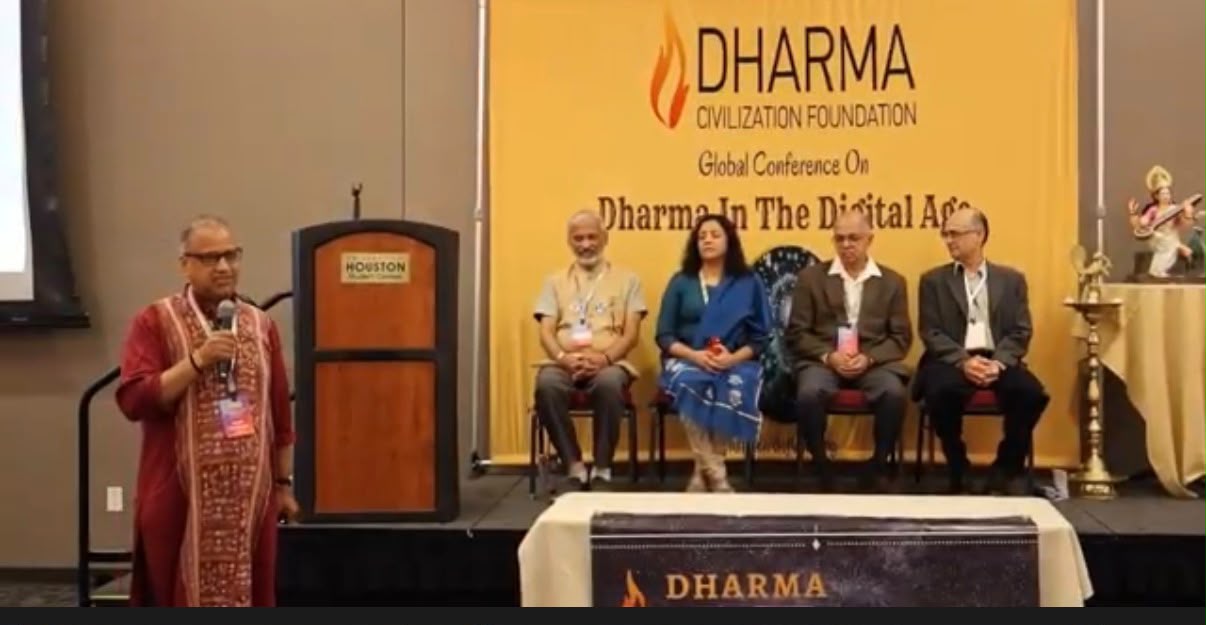
Sustainability: From Exploitation to Equilibrium Panel · DDA '26 · Hilton University of Houston & Student Center · June 2026
We talk about "saving the planet" as though the Earth is something separate from us — a warehouse of resources arranged for our convenience, available for extraction on demand. At DDA '26, the Sustainability panel dismantled this framing directly. The crisis of ecological collapse is not, at its root, a technology problem or a policy problem. It is a perception problem: we have placed ourselves at the centre of a circle that has no centre.
The Dharmic tradition offers a different geometry entirely. Humans are not the hub around which nature revolves. We are one node among many in an intricate web of mutual dependence — equally sacred, equally responsible, and equally accountable to the generations that will come after us. Rina, the concept of debt to nature and to our ancestors, names this accountability precisely. The panel asked: what would modern ESG and ecological policy look like if it were built on that foundation?
"True sustainability isn't about buying a slightly more efficient appliance. It demands a change in human desire — and the Dharmic tradition knows exactly how to cultivate that."
The question we put to attendees — before and during the session
"What is one 'unsustainable' practice in your industry that you want our panel to address?"
Responses came from professionals across healthcare, technology, finance, agriculture, and education. The most common thread: a felt gap between what organisations say about sustainability and what their supply chains, energy use, and consumption patterns actually reflect — especially in the Global South where accountability is often invisible.
Who Was in the Room
The Panelists
Exploring the interface between corporate sustainability practice and the deeper philosophical shifts required to make it meaningful.
Systems thinker at the intersection of industrial ecology and thermodynamics, working toward economic models that account for nature's true value.
Bringing perspectives on regenerative systems and the translation of ecological thinking into actionable frameworks for communities and organisations.
Founder of Climate Healers; champion of a plant-based transition as the most direct path to ecological restoration, drawing from both systems science and Dharmic ethics.
Connecting the dots between policy, technology, and the lived experience of sustainability across diverse geographies and sectors.
The Central Argument
Shifting the Geometry of Relationship
Sailesh Rao anchored the panel's argument with a simple but devastating visual contrast. In the modern model, the human sits at the dead centre of a wheel — trees, water, soil, animals arrayed around the rim as resources to be drawn upon. In the Dharmic model, the centre is empty. Or rather, the centre is the sacred whole itself, and every living being — human included — is a node on the rim, equally part of the circle and equally responsible for its integrity.
This is not poetry. It is a different set of operating assumptions that produces radically different behaviour. When you believe you are the purpose of the circle, consumption is natural. When you understand you are part of the circle, restraint becomes instinctive. The Ishavasya Upanishad encodes this directly: take only what you truly need, and leave the rest for others and for those who will come after.
The panel also named a specific trap that catches even well-intentioned ecological actors: the efficiency fallacy. Making something cheaper or more efficient does not reduce consumption — it typically increases it. The rebound effect is real and well-documented. True sustainability begins with restraint, not with better technology. The technology comes second.
What You Can Do
Five Actions to Begin the Shift
These are not grand gestures. They are small, deliberate movements away from the extractive model — toward the ecocentric one.
Recognise the Efficiency Trap
Just because something is labelled "eco-friendly" or "energy-efficient" does not mean using more of it is harmless. The rebound effect is real: when something becomes cheaper or more efficient, we often consume twice as much of it, wiping out the environmental gain. True sustainability starts with restraint — not just better tech.
Shift Toward a Plant-Based Diet
One of the fastest ways to step out of an extractive relationship with the Earth is to look at your plate. The global food system uses a massively disproportionate amount of land and water to feed farmed animals. Moving toward whole-food, plant-based eating sharply reduces your direct ecological footprint — and connects you to one of the oldest Dharmic practices of non-harm.
Look Past the Green Labels
Be a conscious consumer by questioning corporate ESG claims and eco-certified packaging. Many companies report perfect compliance on paper while their actual supply chains — especially in the Global South — leave a trail of environmental damage invisible to the end consumer. Choose local, transparent, and minimally packaged goods wherever possible.
Bring the Shanti Mantra into Your Home
Adopt the spirit of the Ishavasya Upanishad: take only what you genuinely need, and leave the rest for others and for future generations. Before a non-essential purchase, try a 24-hour pause and ask honestly — is this a true need, or am I extracting more than my fair share from the circle? This single question, practised consistently, reshapes desire over time.
Spend Time in Non-Human Spaces
Reconnect with your inner ecocentrism by spending time in nature without your phone. Walk in a park, care for a garden, sit under a tree. Actively remind yourself that you are not an outside observer managing the environment — you are a living, breathing part of it. This is not a metaphor. It is a perceptual realignment that changes how you act when you return to the built world.
Closing Reflection
Rina: The Debt That Reorients Everything
The Sanskrit concept of Rina — debt — may be the most quietly radical idea the panel introduced. We are born into debt: to the ancestors who built the conditions we inherited, to the ecosystems that sustain us without invoicing us, and to the children who will inherit what we leave behind. This is not a burden. It is an orientation. When you understand your life as a response to a gift, the question of sustainability stops being about compliance and starts being about gratitude expressed as action.
Ecological policy built on this foundation would look very different from what we have now. It would not ask "how little damage can we document?" It would ask "what do we owe, and to whom, and how do we honour that across generations?" The panel did not offer a policy blueprint. It offered something more durable: a way of seeing that makes the right actions feel necessary rather than obligatory.
"When we realise the Earth is an expression of divine grace rather than a giant extraction site, protecting it stops being a bureaucratic chore and becomes a moral duty."
Watch the Full Session
The complete panel recording is available — five voices exploring the philosophical shift from extraction to equilibrium, and what it means to live inside the circle rather than at its centre.
Watch Now →